Features
This is a conceptual overview of how SemlogWeb works. We assum familiarity with at least one NoSQL database (in our case we use MongoDB) and basic image processing methods.
Contents
Framework overview
Many robotic applications have been built in Virtual Realities and are widely used in researches. However, these are mostly only composed with elementary interface for camera setup and data sampling. Our original intention for SemlogWeb is to bridge the gap between all Virtual Realities and perception model.
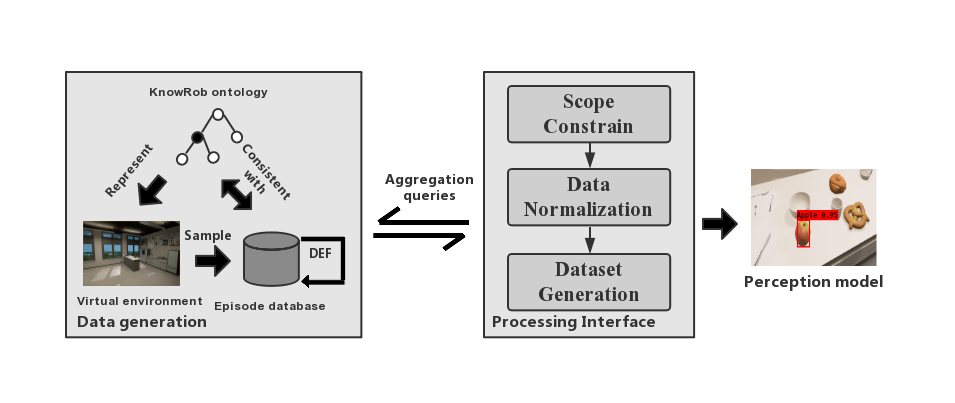
Overview of the proposed framework
The framework contains three components. First is knowledge-based database in which a photorealistic synthetic environment is created for usage of computer vision. The world state and sampled image data are stored in the NoSQL database.
The second component is data processing. Both the Scope Constrain and Data Normalization are available before an synthetic image dataset is generated.
The last component is perception models. SemlogWeb can be connected to many computer vision algorithms. Follow the Demo to go through an example.
Database structure
Give the abundant synthetic image data in the Unreal Engine, images are stored by tasks and episodes. For example, one task could be “Clean the table” or “Move the Strawberry jam to the fridge”. Multiple participants would equip VR equipments and finish the task in the virtual environment. One attempt carried by one participant is stored as an episode in the database. Therefore one task (mapped as one database) will contains many episodes (mapped as one collection).
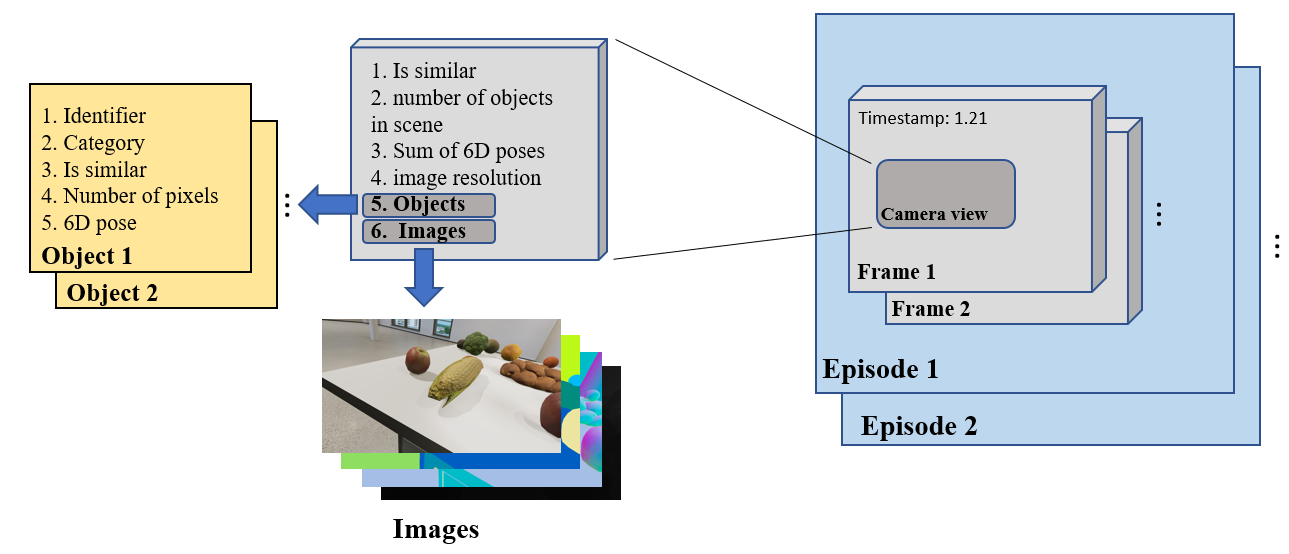
The database structure in MongoDB